
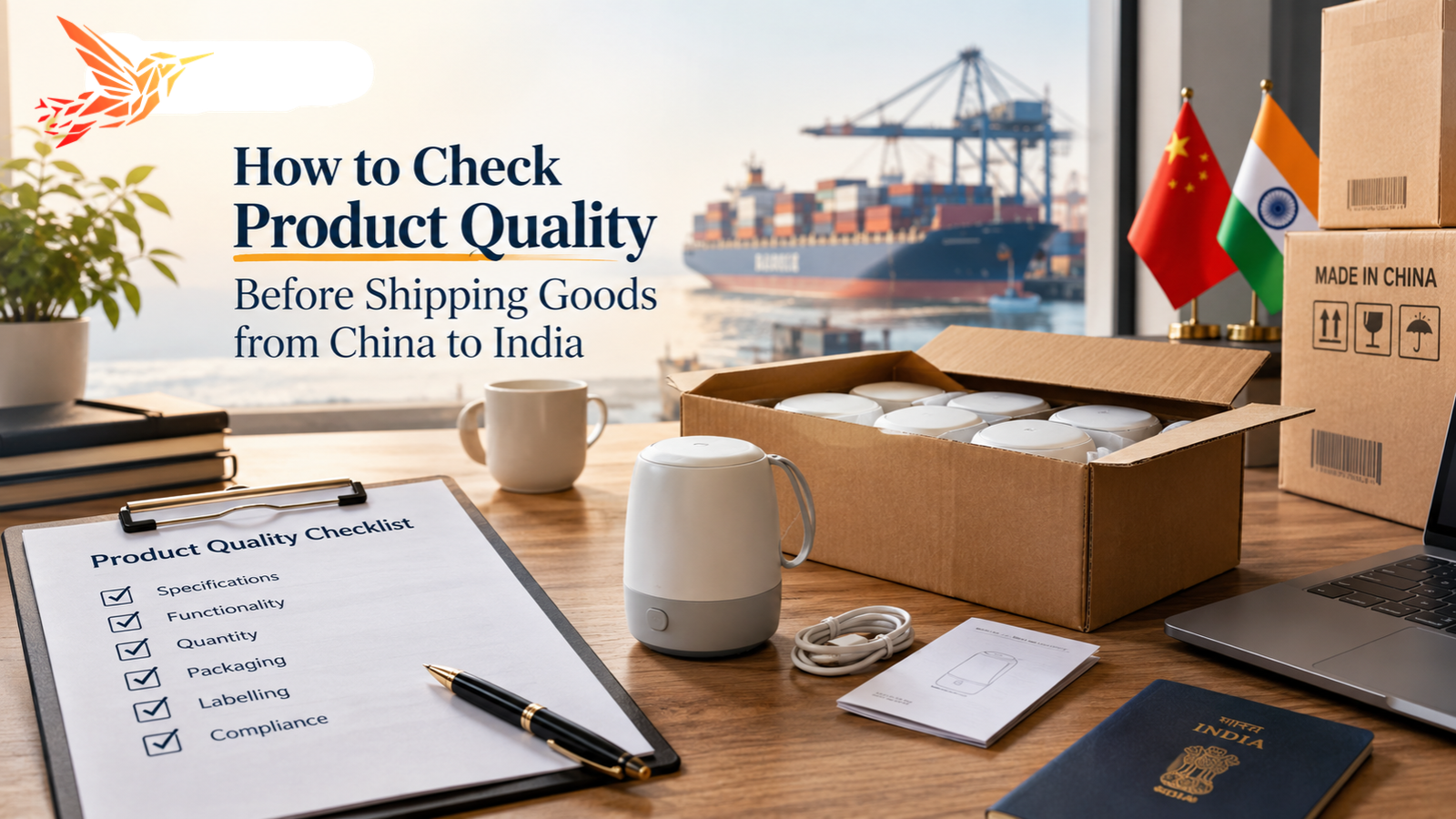
How to Check Product Quality Before Shipping Goods from China to India
A product can look right in photos and still be wrong
A Chinese supplier shares product photos, confirms the price and gives you an estimated shipping date. Everything appears fine until you discover that the finished goods do not match the sample you approved.
The material is different. Some accessories are missing. The packaging is weak, or the product does not work as expected.
For Indian businesses, these problems can lead to delayed deliveries, replacement costs, and disagreements with suppliers. That is why it is important to check product quality before shipping from China to India, rather than waiting until the goods arrive.
Whether you are importing electronics, garments, household products, or industrial components, a proper China product quality inspection helps you identify potential issues before dispatch.
This guide explains how to check Chinese supplier quality, arrange a pre-shipment inspection in China, verify product specifications, and prepare your shipment for import into India.
What should you check before shipping products from China?
Before choosing an inspection method, focus on five essential areas.
| Inspection area | What to verify |
| Product specifications | Model, materials, dimensions and features |
| Workmanship and functionality | Defects, finishing and product performance |
| Quantity and accessories | Correct units, components and spare parts |
| Packaging and labelling | Protection, product identification and required labels |
| Import compliance | Applicable Indian certification and documentation |
These checks help you determine whether the goods match your purchase agreement. However, product quality inspection and Indian import compliance are separate requirements. Passing an inspection does not automatically mean a product is approved for import or sale in India.
1. Approve a sample before bulk production
One of the simplest ways to reduce product quality issues when importing from China is to approve a sample before the supplier starts bulk production.
Ask for a sample and compare it with your requirements. Do not rely only on catalogue images or verbal assurances.
Check the following:
- Material and component specifications.
- Dimensions, weight and acceptable tolerances.
- Colour, finish, stitching or printing.
- Product functionality.
- Accessories and included parts.
- Packaging and labelling requirements.
Keep photographs of the approved sample and record the specifications in writing. This creates a reference for the supplier and the person carrying out the quality inspection before shipping.
For example, an Indian distributor ordering 1,000 kitchen containers may specify the required material, capacity, lid fit and finish. If the bulk order uses a different material from the approved sample, the difference can be identified during inspection before the products leave China.
The approved sample is a reference point, but it does not replace checking the finished goods.
2. How to verify a Chinese supplier before placing an order
A Chinese supplier quality check should cover more than the product itself. You should also understand who is manufacturing the goods and who will be responsible for quality control.
Before confirming a bulk order, request:
- The supplier’s registered business name and address.
- Details of the actual manufacturing facility, if different.
- Confirmation of who manages production quality.
- Information about subcontracted manufacturing, where relevant.
- Available product test reports and previous inspection records.
- Written confirmation of specifications and defect criteria.
Where practical, verify business details independently. If the supplier provides a certificate or test report, check whether it applies to the actual product, model and manufacturer you intend to purchase.
A document carrying a laboratory name or certification logo is not enough on its own. Its scope and validity must be appropriate for your goods.
Before placing an order, also agree on what happens if the products fail inspection. Clarify the process for rework, replacement, reinspection and associated costs in writing.
Businesses working with a China sourcing agent in India should also clarify whether supplier verification, product inspection and compliance coordination are included in the agreed service. These responsibilities should never be assumed.
3. Choose the right type of product inspection in China
A product inspection in China can take place at different stages of production. The appropriate timing depends on the product, order value and potential consequences of a defect.
Pre-production inspection
This is useful when materials, components or custom specifications are important. It helps establish whether the supplier is ready to manufacture according to the agreed requirements.
During-production inspection
A during-production inspection can identify recurring problems while manufacturing is still underway. This may be particularly useful when a defect could affect a large quantity of goods.
Pre-shipment inspection
A pre-shipment inspection in China checks finished products before dispatch. Depending on the agreed scope, it may cover product specifications, workmanship, functionality, quantity, packaging and visible defects.
For many finished-product orders, this is a useful final checkpoint before approving shipment to India.
Container loading inspection
A loading inspection focuses on carton counts, handling, loading condition and shipment security. It does not replace a detailed product quality inspection.
Which inspection should you choose? For a straightforward order, a pre-shipment inspection may be sufficient when combined with clear specifications and suitable checks. For expensive, customised or technically complex goods, earlier inspections may be worthwhile.
4. Create a product quality inspection checklist
A generic instruction such as “check quality” is not enough. Your inspection checklist should translate the purchase agreement into checks that can be measured or demonstrated.
| Checkpoint | What to verify |
| Product identity | Correct model, SKU, colour and version |
| Quantity | Number of finished units and cartons |
| Materials | Agreed material and components |
| Dimensions | Measurements and tolerances |
| Appearance | Scratches, stains, stitching and finish |
| Functionality | Relevant operating tests |
| Accessories | Required cables, parts, manuals or fittings |
| Packaging | Product protection, carton strength and sealing |
| Labels | Barcodes, model numbers and required markings |
| Documents | Applicable test reports and compliance records |
The inspection criteria should match the product.
- Electronics: Check model numbers, connectors, basic functions and applicable safety or performance requirements.
- Garments: Check fabric specifications, measurements, stitching, colour consistency and labels.
- Household products: Check material, dimensions, assembly, finish and relevant product-specific requirements.
- Industrial components: Check dimensions, tolerances, material grade and required performance tests.
- Toys and children’s products: Check construction, applicable safety requirements, labelling and relevant test documentation.
For products requiring specialist equipment or laboratory tests, a visual inspection alone may not be sufficient.
5. How does a pre-shipment inspection work?
A pre-shipment inspection in China helps determine whether finished goods meet the buyer’s agreed requirements before dispatch.
Depending on the order, you may use the supplier’s internal quality team or an independent inspection company with relevant product experience.
Follow these five steps:
Step 1: Share the specifications. Provide the purchase order, approved sample details, packaging requirements and defect criteria.
Step 2: Confirm that the goods are ready. Establish how many units are finished, how many are packed and where the inspection will take place.
Step 3: Agree on the inspection method. Decide how units will be selected, which tests will be performed and what constitutes an acceptable result.
Step 4: Record the findings. Document relevant measurements, test results, quantities, defects, packaging condition and photographs.
Step 5: Review the report before dispatch. Compare the findings with the agreed acceptance criteria. If the goods fail, agree on corrective action and arrange a follow-up inspection when necessary.
An independent inspection can provide an additional layer of verification for higher-risk orders. Choose a provider with relevant product experience and agree on the inspection scope before the visit.
6. What is AQL in product quality inspection?
When importing large quantities, checking every unit may not be practical. In such cases, buyers may use acceptance sampling to assess whether a production lot meets defined acceptance criteria.
AQL stands for Acceptance Quality Limit. It is used in statistical sampling plans and is not a guarantee that every unit is defect-free.
ISO 2859-1:2026 covers acceptance sampling schemes indexed by AQL for lot-by-lot inspection. Read the official ISO information.
An appropriate sampling plan depends on the lot size, inspection level, defect classification and acceptance or rejection criteria.
Before the inspection, agree on:
- The batch being inspected.
- How samples will be selected.
- What counts as a critical, major or minor defect for the product.
- The applicable acceptance and rejection criteria.
- What happens if the lot does not pass.
For example, a cosmetic mark on a non-safety-critical product may be treated differently from a defect that creates a safety risk. Defect categories must be appropriate for the product and purchase agreement.
Do not select an AQL value simply because a supplier recommends it. Choose a suitable plan based on product risk, customer expectations and the consequences of failure.
7. Check packaging and labels before shipping to India
A product may pass its functional checks but still arrive damaged because of unsuitable packaging.
During the quality inspection before shipping, verify that the packaging protects the goods during expected handling and transportation.
Check:
- Individual product protection and inner packaging.
- Carton strength, sealing and quantity.
- Moisture protection where required.
- Cushioning and separation for fragile products.
- Product identification and carton markings.
- Barcodes, instructions and required labels.
- Consistency between packed goods and shipment details.
For example, glass products may require suitable cushioning and separation. Electronic products may need protection against moisture or electrostatic discharge, depending on their design.
If you are importing goods under your own brand, approve the final packaging artwork and label specifications before production. Correcting packaging after the goods have been packed can cause unnecessary delays.
8. Check Indian import compliance before dispatch
Product quality is only one part of the China to India import process. You must also determine whether the product meets the applicable Indian import and sale requirements.
Depending on the product, requirements may include BIS certification, a relevant Quality Control Order (QCO), product-specific registration, labelling rules or other regulatory approvals.
The Bureau of Indian Standards explains that certification is generally voluntary but compulsory for products covered by applicable government notifications and QCOs. Check the official BIS list of products under compulsory certification.
Before shipping, confirm:
- The exact product category and applicable Indian standard, if any.
- Whether mandatory certification or registration applies.
- Whether the documentation covers the actual manufacturer and model.
- Whether required product markings and labels are correct.
- Whether any additional import conditions apply.
You should also verify the applicable customs classification, documentation and duties. Requirements depend on the product and the rules in force at the time of import.
Do not assume that a supplier’s existing certificate automatically covers your goods. Verify its scope and applicability with the relevant authority or a qualified compliance professional.
9. What should you do if products fail inspection?
If a shipment does not meet the agreed specifications, the next step depends on the defect, the quantity affected, your purchase agreement and any applicable safety requirements.
Use this corrective-action process:
1. Document the issue. Keep photographs, measurements, test results and details of the affected units.
2. Compare the findings with the agreement. Identify which specification or acceptance criterion was not met.
3. Request a corrective-action plan. Ask the supplier to explain how the problem will be fixed and how recurrence will be prevented.
4. Agree on the remedy in writing. Depending on the circumstances, options may include rework, replacement, sorting or additional testing.
5. Arrange reinspection where necessary. Confirm that corrective work has addressed the original problem.
6. Approve dispatch only when appropriate. Consider the inspection findings, contractual terms and applicable Indian compliance requirements.
If the issue concerns product safety or mandatory certification, a cosmetic repair or a new photograph is not sufficient proof of compliance.
Agree on the process for failed goods before production is complete. Resolving these questions before dispatch is generally easier than trying to negotiate after the shipment reaches India.
10. Example: Checking a bulk order before shipping from China
Imagine an Indian distributor ordering 1,000 rechargeable desk lamps from a Chinese manufacturer.
The purchase agreement specifies the model, charging port, included accessories, packaging and required compliance documents.
During the pre-shipment inspection, three problems are identified:
- Some lamps have a different charging port from the approved sample.
- Several boxes are missing the promised charging cable.
- A submitted test report refers to a different model number.
The first two are product-conformity problems. The third requires document verification because the report may not apply to the ordered model.
The buyer records the findings and asks the supplier to correct the product and packaging issues. The buyer also requests documentation that applies to the actual model and verifies the relevant Indian compliance requirements.
After corrective work, the goods are checked again. Dispatch is approved only when the agreed quality criteria are met and the documentation concern has been resolved.
This is an illustrative example, not a reported Surti & Co. customer case. It demonstrates why China product quality inspection should cover specifications, accessories, packaging and applicable documentation—not just appearance.
11. Pre-shipment checklist for Indian importers
Before approving your next shipment, check that:
- Supplier and manufacturing details have been reviewed.
- The product sample or written specifications have been approved.
- Inspection criteria and defect categories are agreed in writing.
- The inspection method and timing have been decided.
- Product identity, quantity and relevant functions have been checked.
- Packaging and labels match the agreed requirements.
- Inspection failures have a documented corrective action.
- Applicable Indian certifications, registrations and import rules have been verified.
- The final inspection report and shipment documents have been reviewed.
Keep the report, photographs and supplier communications with your purchase records. They can help resolve disagreements and provide a reference for future orders.
How Surti & Co. can help with China imports
Finding a supplier is only one part of importing goods from China to India. Businesses also need to consider product specifications, supplier coordination, shipping details and applicable Indian compliance requirements.
If you are preparing a bulk order, clarify who will verify the goods, what the inspection will cover and how defects will be handled before dispatch.
Surti & Co. assists businesses with China import and sourcing-related requirements. If you are evaluating a new order, visit Surti & Co. to learn more about its services.
Before engaging any service provider, confirm the exact scope of assistance available, including whether factory inspection is included or needs to be arranged separately.
Final takeaway
Before importing goods from China to India, make sure you know exactly what you are buying and how you will verify it.
Approve the specifications, choose an appropriate inspection method, document defects and confirm the relevant Indian requirements before dispatch. These steps cannot eliminate every risk, but they can help you identify problems before they become harder and more expensive to resolve.
Frequently asked questions
How can I check product quality before shipping from China to India?
Approve a sample, document the specifications, arrange a suitable inspection and check finished goods against the agreed criteria. Verify quantities, functionality, packaging and applicable compliance documents before dispatch.
What is a pre-shipment inspection in China?
A pre-shipment inspection checks finished goods before dispatch. Depending on the agreed scope, it may cover specifications, workmanship, functionality, quantity, packaging, labelling and visible defects.
Should I hire a third-party product inspection company in China?
An independent inspection company may be useful for high-value, customised or technically complex orders. Choose a provider with relevant product experience and agree on the inspection scope and acceptance criteria in advance.
What does AQL mean in product inspection?
AQL stands for Acceptance Quality Limit. It is used in statistical acceptance-sampling plans to assess a production lot against defined criteria. It does not guarantee that every uninspected unit is defect-free.
Can I inspect products after they arrive in India?
Yes, but resolving a problem may be more difficult once the goods arrive. A pre-shipment inspection provides an opportunity to address defects while the products are still with the supplier. Some checks may still be necessary after arrival.
Does product inspection guarantee customs clearance in India?
No. Customs clearance depends on applicable customs rules, classification, documentation, duties, restrictions and any required approvals or certifications.
Is BIS certification required for every product imported from China?
No. BIS certification is mandatory for products covered by applicable government notifications and Quality Control Orders, but not for every product. Check the current official requirements for your exact product before shipping.
What should I do if my products fail inspection?
Document the defects, compare them with the agreed specifications, request a corrective-action plan and agree on rework or replacement where appropriate. Arrange a follow-up inspection when needed and resolve applicable compliance issues before dispatch.
When should I arrange product inspection in China?
The timing depends on the product and its risks. Checks may take place before production, during manufacturing, after the goods are finished or during loading. A pre-shipment inspection is a useful final checkpoint for many finished-product orders.