
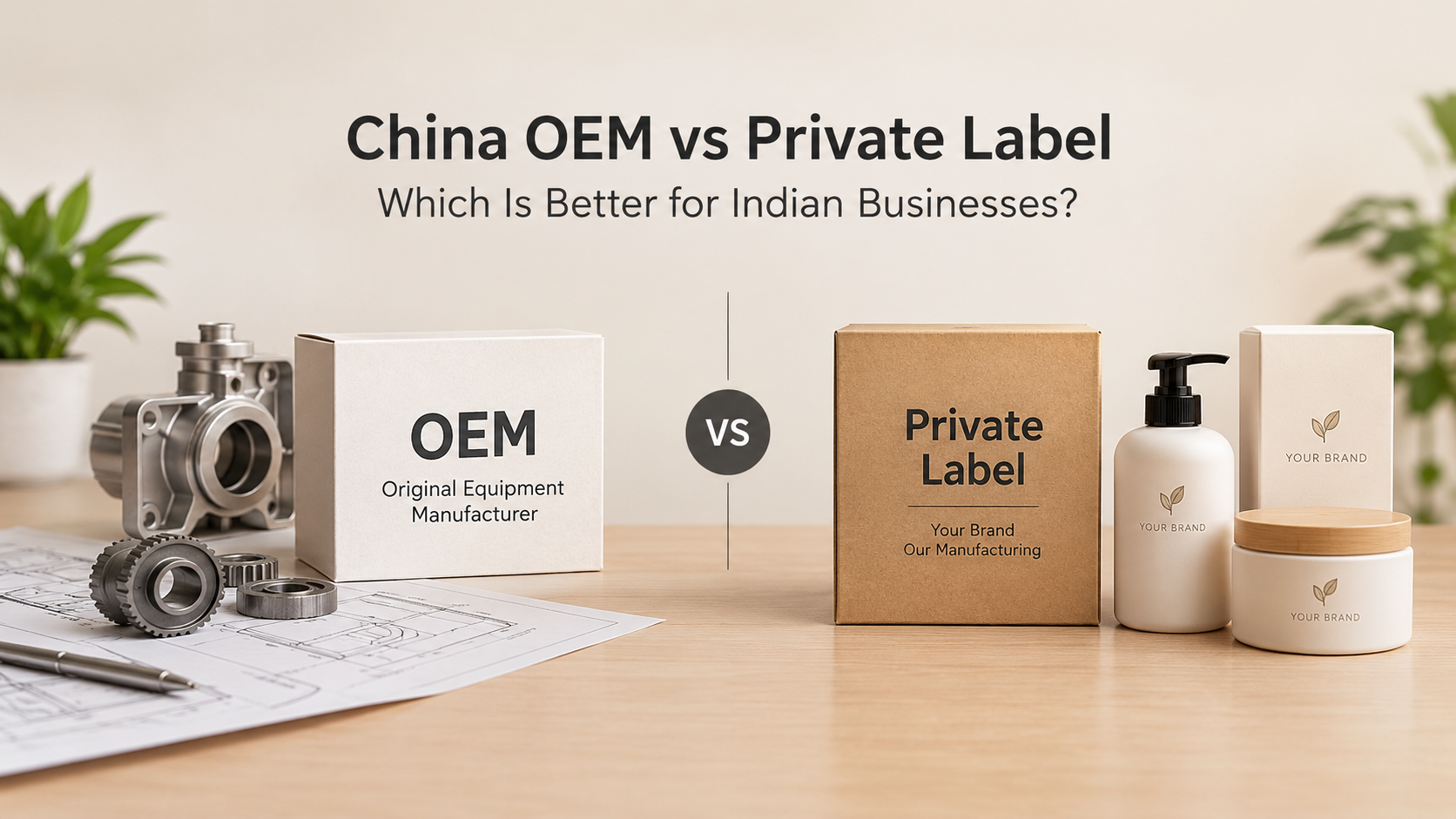
China OEM vs Private Label: Which Is Better for Indian Businesses?
If you are planning to launch a product under your own brand, China can open up a wide range of manufacturing options. But before you start contacting factories, there is one important decision to make: should you develop a product with a manufacturer, or start with an existing product and sell it under your brand?
This is where OEM and private label manufacturing come into the picture.
The two terms are sometimes used interchangeably, but they are not always the same in practice. The amount of customisation, development work, order quantity, cost and supplier requirements can differ considerably.
So, which option makes more sense for an Indian business?
The answer depends on your product, budget, target market and how much control you want over the final product.
What Does OEM Mean?
OEM stands for Original Equipment Manufacturer.
In an OEM arrangement, a manufacturer produces a product according to specifications provided or agreed upon with the buyer. Depending on the project, those specifications can cover the product’s design, dimensions, materials, components, features, packaging or other requirements.
For example, imagine you have identified a gap in the Indian market and want a product with specific dimensions and features that are not available in a supplier’s standard catalogue. You may work with a manufacturer to develop or modify the product according to your requirements.
That generally means more work before mass production begins.
You may need to go through product discussions, samples, revisions, pricing negotiations and quality checks before approving the final version.
OEM can therefore be a suitable route when the product itself is an important part of your brand’s differentiation.
What Is Private Label Manufacturing?
Private label usually starts with a product that a manufacturer already produces.
The business then sells that product under its own brand, subject to the manufacturer’s capabilities and the agreed requirements.
Depending on the supplier and product, you may be able to customise elements such as:
- Brand name and logo
- Packaging
- Labels
- Colours or finishes
- Product variations
- Inserts or instructions
For example, a manufacturer may already produce a particular home or kitchen product. Instead of developing an entirely new product, you could source that product and have it prepared for sale under your brand.
This can make private label a practical option when you want to build a branded product range without starting product development from scratch.
However, private label does not mean that every supplier will offer the same level of customization. MOQ, packaging options, branding, product modifications, and pricing need to be discussed with the manufacturer.
OEM vs Private Label: What’s the Difference?
The easiest way to understand the distinction is to look at where you are starting.
OEM: You have specific product requirements and work with a manufacturer to produce the product accordingly.
Private label: You generally start with an existing manufacturer product and put your brand around it, with customization depending on the supplier.
Here’s a simple comparison:
| Factor | OEM | Private Label |
| Starting point | Specific product requirements | Existing product |
| Customisation | Generally greater | Usually more limited |
| Product development | May be required | Usually less involved |
| Time before production | Can be longer | Can be shorter |
| Investment | Depends on development and order requirements | Depends on product, MOQ and customisation |
| Best suited to | Businesses seeking product differentiation | Businesses building a brand around existing products |
These are general differences, not fixed rules. Every manufacturer has its own capabilities, MOQ, pricing and production process.
When Does Private Label Make Sense?
Private label can be worth considering if you have found a product with potential demand and your main goal is to build a brand around it.
It may suit businesses that want to:
- Test a product category before investing heavily in development
- Launch a branded product range
- Customise packaging and presentation
- Start with an established product design
- Focus their resources on branding, marketing and sales
For a first-time importer, this can sometimes be a simpler starting point than developing a completely new product.
But simpler does not mean you should skip due diligence.
You still need to assess the manufacturer, request samples where appropriate, understand the MOQ, confirm the agreed specifications and check the quality of the product before committing to a larger order.
When Should You Consider OEM?
OEM may be a better fit when an existing product does not meet your requirements.
Perhaps you want a different material, size, design, feature or specification. Or maybe you have developed your own product concept and need a manufacturer capable of producing it.
In such cases, the process can involve more back-and-forth with the factory.
Samples may need to be reviewed and changed before the final product is approved. The more specific your requirements are, the more important it becomes to document exactly what the manufacturer is expected to produce.
This is also where supplier selection becomes critical. Not every factory that can produce a similar product will necessarily have the equipment, experience or production capacity required for your particular specification.
Don’t Compare Suppliers on Unit Price Alone
A quotation of $5 per unit from one supplier and $4.50 from another does not automatically mean the second supplier is cheaper.
Your actual import economics can depend on several factors, including:
- Product price
- MOQ
- Packaging
- Product customisation
- Inspection costs
- Freight
- Customs duties and applicable taxes
- Customs clearance
- Local transportation
- Other applicable import costs
This is why landed cost is more useful than looking at the factory price alone.
A supplier offering a lower unit price may have a higher MOQ, different packaging costs or other conditions that change the overall economics of the order.
What Should You Check Before Placing an Order?
Whether you choose OEM or private label, take time to evaluate the supplier before committing to production.
Start by asking practical questions:
Can the manufacturer meet your specifications?
If you need custom dimensions, materials or packaging, confirm these capabilities before proceeding.
What is the MOQ?
A low per-unit price may only apply to a large order. Make sure the quantity works for your business.
Can you get a sample?
A sample gives you an opportunity to assess the product before approving a larger quantity. For customised products, you may need to review samples more than once.
How will quality be checked?
Make sure the final production requirements are clear and consider appropriate inspection before shipment, particularly for larger or customised orders.
Are there Indian compliance requirements?
This depends on the product category. Some products may be subject to specific Indian standards, certifications, labelling or other regulatory requirements. These should be checked before placing the order, rather than after the goods have been manufactured.
So, Which One Should You Choose?
There is no single answer that works for every business.
If you want to take an existing product and build your own brand around it, private label may be the more practical starting point.
If you have specific product requirements and want greater control over how the product is made, OEM may be more appropriate.
But the decision should not be based on the label alone.
Look at the complete picture: product requirements, MOQ, supplier capability, quality, investment, compliance and landed cost.
A product that looks attractive on a supplier’s website may not necessarily be the right product for your market.
Planning to Source a Product From China?
Finding the right manufacturing model is only the first step.
You may still need help identifying suitable suppliers, comparing quotations, arranging samples, verifying a factory, checking product quality and coordinating shipping and customs clearance.
Surti & Co. works with businesses looking to source and import products from China to India, with support across sourcing, supplier and factory verification, samples, product inspection, shipping, customs clearance and door-to-door import requirements.
If you already have a product in mind, you don’t need to start with a large order.
Share your product details, expected quantity and destination with Surti & Co. You can then assess the sourcing options and understand what needs to be considered before committing to production.